✓ Ready for Publication
Coach / partner signoff received. Article is ready to publish to the QuintAce blog or partner platform. Once truly published, it leaves this repo's tracking.
🃏 Poker Content
solver-anchored articles co-authored with coaches and partners 5Why the solver widens for antes — and tightens the button for straddles
Antes and straddles both put chips in the pot before the hand. The solver treats them very differently. Antes widen every position uniformly. Straddles tighten every non-straddle seat — the button drops 9.6 percentage points and the small blind drops 30. The asymmetry reshapes every seat's preflop strategy; the article works through the mechanism and the position-by-position playbook.
Phil Ivey's most legendary hands — solver-graded by QuintAce
The most publicly-discussed Ivey hands in televised poker — from the Moneymaker cooler at the 2003 WSOP Main Event through the Paul Jackson bluff war at Monte Carlo '05, the $676K Dwan tank-fold on High Stakes Poker, and the Guinness-record $1.1M MDCG pot — put through the QuintAce solver. The public memory of Ivey is mostly mystique; the solver quantifies it, one decision at a time.
QuintAce Graded My Dumbest Hands. It's Not What You Think.
JRB hands over 13 of his most-discussed televised hands for solver grading. The actual fold leak is one hand — the QQ fold to Salomon, ~$172K every time the spot comes up. The famous AK fold to Persson is a right fold per combo (the solver agrees). One correct call unwound by verbal pressure (Robl's flush-rep). The Adelstein top-two call every commentator said was wrong — the solver says was right. The leak isn't misread opponents; it's conviction under pressure.
The 5 Questions Patrik Antonius Wants a Modern Solver to Settle
Patrik Antonius tests his own intuition against the modern solver on five spots that matter at the top of the game — solver-right intuitions that are off by more than you'd expect, deep-stack complexity that breaks the 100bb answer, population under-bluffing, sizing cliffs inside the plateau, and the exploit against the modern studied cohort. One of the best cash players of the last two decades walks through what the solver confirms, where it catches him out, and what that gap means for the rest of us.
The squid is an invisible ante — here's the napkin math + sizing shortcut
Uri Peleg dictates Stand-up Game from first principles in four passes: name it as a reverse sit-and-go, price the squid button (3 → 18 BB depending on stage), reframe the squid value as an invisible ante in every pot, then turn that into the 'raise to size of squid = effective min-raise' shortcut and the effective-stack shrink that follows. The pedagogical angle that distinguishes this from Dan's mental-models article: practical sizing + stack-depth implications.
👁 Currently in Review
Named partner is actively reviewing. v1.md is at production quality; iterations land on the live URL.
🃏 Poker Content
solver-anchored articles co-authored with coaches and partners 7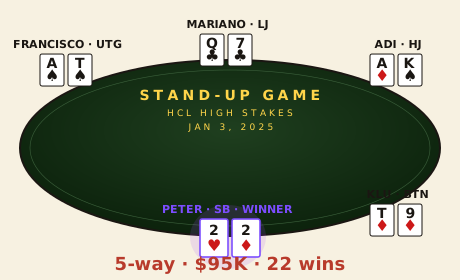
Every Format, Every Game — HCL 5-way Stand-Up preflop all-in
Five-way preflop all-in on Hustler Casino Live's Stand-Up Game (Jan 3 2025). Francisco AsTs · Mariano Qc7c · Adi AdKs · Klu Td9d · Peter 22. $95K pot. Peter's deuces hold.
Henry Guttman Ran a Bluff That Shouldn't Exist — and It Worked
Guttman jams $113k with 55 on K♦9♥4♥3♣4♦, making Airball fold KQ. Pocket fives is a flop fold in equilibrium — it barely exists at the river node. QuintAce extrapolates the off-tree strategy to show exactly how far outside the solver's tree the bluff sits.
At 750bb deep on HSP Season 3, KK facing a $286K all-in on 7♠6♦3♦ is not the snap call everyone remembers. The math explains why Ivey's fold was defensible.
Brad Booth shoves $286,000 into Phil Ivey's KK on a low flop at 750bb. The internet says call. The pot geometry says otherwise. A breakdown of how extreme depth turns a standard overpair into a genuinely close fold — with a QuintAce solver pull (disclosed as extrapolation past training coverage) to back it up.
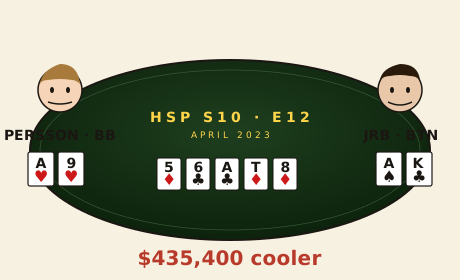
Stuck With GTO — multi-style comic series
Famous-hand spotlights where every GTO solver fails. Episode #1 (the JRB fold at 1,140bb) ships in 8 visual languages — Marketoonist, Kaiji manga, Brosh, Sci-Fi Pulp, xkcd, RoughJS, Drake, Lichtenstein. Story locked, channel picks the style.
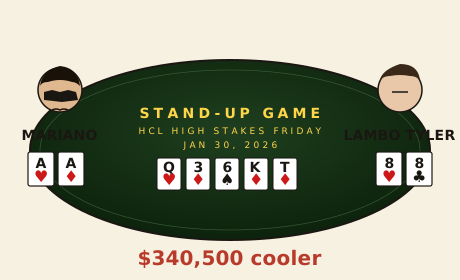
Every Format, Every Game · Ep 1 — Mariano's $340K Stand-Up cooler
Mariano with pocket aces in HCL Stand-Up Game (val=3, ~1260bb effective). The $340K cooler that vanilla solvers misanalyze because they don't model the Stand-Up Game token economy.
Intuition Hints, the Solver Answers: A Re-read of Easy Game
Good poker intuition points at the right target. The solver tells you whether the target actually exists, how close you were to the coordinates, and what to do when you get there. We run 8 of Andrew Seidman's load-bearing claims from *Easy Game* through the QuintAce solver and grade each one — intuition on the money, intuition pointed at the right target but wrong coordinates, or intuition pointed at a ghost. Seidman responds inline to each verdict.
The solver says mix. You can't. Now what?
Xuan Liu brings a claim she's held for years — that the solver's mixed strategies are unplayable, so the practical question is always 'what's the best pure?' QuintAI tests it across three spots. Xuan responds. Two minds, two methods, one spot. The inaugural Strategy Debate column.
📰 Press Content
outlet pitches and manifesto pieces by Thanh — AceGuardian + QuintAce 3GTO Is a Poker-Industry Story. The Cutting Edge of Gameplay AI Has Always Been Somewhere Else.
For the poker industry, GTO is ground truth. For the broader field of gameplay AI — AlphaStar, OpenAI Five, Suphx, AlphaGo, Cicero — pure equilibrium-seeking has never been the cutting edge. The strongest game-AI systems for over a decade have been built on deep reinforcement learning, or DRL combined with search. The poker industry's marketing layer is the last place treating pure GTO as the frontier.
Why DRL Is the Default Solver — and Where Full CFR Still Helps as a Cross-Check
For abstracted poker games where full CFR can run to convergence, DRL tracks closely with the CFR ground truth — fast, broad-coverage, no memorization issues. For the games CFR can't reach (large state spaces, Squid, multi-street complexity), DRL is the only practical option. Where the cross-check still matters and where it doesn't.
When QuintAce, GTO Wizard, and Other Solvers Disagree
Most of the time, DRL and CFR-class solvers agree on the same hand — internal benchmarks (1755-flop FCR coverage, decision-level convergence) confirm this. The interesting and pedagogically valuable cases are where they disagree, and what those disagreements reveal about each method's blind spots.
✏︎ Drafting
Active drafting / iteration. Not yet handed to the named partner for formal review. Cards without a rendered preview are still at outline stage.
How we classify articles
Every piece in this hub has three orthogonal classifications. When you're proposing a new article, work the matrix below: pick an anchor, a trigger, and a USP claim. Articles that hit underserved cells (see "Coverage" at the bottom) are the highest leverage.
1. WHO anchors
- 🃏 A · Ambassador-led Coach or named poker pro (Brad, Uri, JRB, Patrik, Ivey, Seidman, etc.)
- 🤝 B · Partner content Operator / show / brand (HCL, WPT, ClubGold, Coin Poker, Triton, GTO Lab)
- ◈ C · QuintAce voice Manifesto, methodology, founder POV
2. WHAT triggers it
- 1 · Famous hand Recognizable historical hand (Ivey vs Jackson, Cynn 199-hand, Dwan tank-fold)
- 2 · Topical Recent event — last week's HCL, Triton this month, news
- 3 · Mechanism Evergreen teaching of a concept
- 4 · Series Cross-comparison or multi-piece arc
3. WHICH USP it demonstrates (matches the locked Pro Strategy Feature 4)
| 🎯 α · Off-tree | Instant solve any spot — DRL has no precomputed library. Feature 4.1. Library tools fail with "spot not in dataset." |
| 🔀 β · Multiway pots | 3-way, 4-way, 5-way at full game-tree fidelity. Feature 4.2. CFR-class tools struggle architecturally. |
| ⚙️ γ · Non-standard formats | Big Ante, three-blind, deep stacks (500bb+), MTT ICM, Bomb Pots — variations within NLHE. Feature 4.3. |
| 🃏 δ · Non-standard games | Stand-Up Squid, PLO4/5, Bounty MTT, Guandan — entirely different games. Feature 4.3. No commercial solver has trained data. |
| 🧨 ε · Exploit vs population | Non-GTO best-response vs caller / maniac / nit / station archetypes. Feature 4.4 + 'Who you'll face' + 'What you're doing wrong'. |
| 📰 ζ · AI methodology | DRL + search, published benchmarks (Pio 299/300, ICM 0.28% MAE). Foundation under all of Feature 4. Mostly press / manifesto. |
Current coverage — where the gaps are
Drafts cluster heavily on δ · Non-standard games (Squid-heavy). The biggest under-produced cells:
- α off-tree: ~0 dedicated articles. Highest-leverage gap — real-game USP, perfect for weekly topical content.
- β multiway: ~1 implicit (HCL 5-way). Big gap — multi-way hand-of-the-week.
- ε exploit vs population: ~4. Under-served given this maps to 3 of the 4 Pro Strategy money levers.
- γ non-standard formats: ~5. OK but could use more Big Ante / MTT ICM bubble / Bomb Pot showcases.
- Partner anchor (B): only 3 (all HCL). Nothing for WPT, ClubGold, Coin Poker, Triton, GTO Lab.
- Topical trigger (2): only 1. Cadence opportunity — weekly "last week's biggest hand, solver-graded."
Filter when proposing a new article: prefer α / β / ε over more δ. Pair coach (A) with a partner (B) when possible. Aim for topical (2) over evergreen (3) when shareable.
🃏 Poker Content
solver-anchored articles in active drafting 28📰 Press Content
outlet pitches at outline stage 15📚 Books
Stateless-regenerated research manuals (six total). Multi-chapter, LLM-in-content-path pipeline. Internal-rebuild only — books are read-only reference here. Rebuilds require upstream source data + Anthropic API key; run from Thanh's local environment.
The 8 Pillars of Poker Strategy
and what our solver says about each
51 foundational poker theories from modern GTO literature, tested against our solver at scale. Eight pillars covering equity and ranges, frequencies and balance, position, sizing, board texture, multi-street strategy, advanced concepts, and 3-bet pot dynamics. All theories carry source links and confidence badges.
Stand-up Game
the first strategy manual
QuintAce's proprietary poker variant (aka Squid Classic) where each pot carries a game-end win token and whoever finishes without one pays a penalty. Nobody else has published strategy research on it. Ten solver-verified mechanisms, grounded in the literal game rules. v1.8.0 complete rebuild with methodology refresh.
Cash NLHE Format Transitions
how your strategy shifts when the format changes
How ante structure, table size, stack depth, rake, and compound transitions reshape GTO strategy. Five chapters, each grounded in solver-verified mechanisms. All chapters published.
Opponent Modeling & Exploitation
what real opponents do, and how to adjust
Most poker research asks what the solver does. This book asks what real opponents do, how far that is from GTO, and what the optimal counter-strategy is. Starting with bots — the most documented player type in our pool. 12 ranked behavioral signatures, the 'fake nit' paradox, and the sizing polarity inversion that breaks standard MDA logic. **Currently WIP** — awaiting additional research-team data; structure stable, content expansion pending.
PLO4 — Strategy Divergence
where PLO strategy diverges from Cash NLHE
How the trained PLO4 model plays Pot-Limit Omaha versus the Cash NLHE baseline. Nine mechanisms (M1-M9), all T1, covering paired-board cbet suppression, limp-depth inversion, connected-board cbet elevation, wider opens, wider BB defense, turn probe elevation, depth-dependent defense against EP openers, river bet direction reversal after BB turn probes, and BB 3-bet behaviour against LP openers. ~179 solver queries across 9 iterative batches; STOP declared.
PLO4 — Strategy from Zero
how the solver plays PLO from the ground up
Same solver research as our Strategy Divergence book (5b), reframed for readers learning PLO as a standalone game. No NLHE references. Nine mechanisms explained from PLO-native reasoning.
NLHE → PLO Heuristic Migration
which NLHE habits work in PLO and which break
One-page migration cheat sheet. Every significant NLHE heuristic → PLO correction with representative solver data. Designed for competent NLHE players who just sat down at a PLO table.
MTT — Strategy Divergence
how tournament play diverges from cash
How the trained MTT model plays multi-table tournaments versus Cash NLHE, classified across all 8 Cash pillars (A–H) plus Pillar M (MTT-native). 62 theory entries: 23 TRANSFER CLEANLY, 8 AMPLIFY, 1 TEXTURE-SPLIT/REVERSE, 5 MTT-SPECIFIC MODIFICATION (G4 ICM expanded), 15 UNTESTED (Pillar F multi-street, Pillar H 3-bet pots, shallow-D), 10 Pillar M natives (bounty pricing, stage binning, M-ratio, push-fold crossover, SB limping, chip utility, early-ICM engagement). 8 solver-verified mechanisms (M1–M8) all T1 at single-checkpoint. 914 solver queries (497 MTT + 417 Cash); B1 trust gate 40/55 PASS with identical Cash fail set (E4 Cash NLHE→MTT PASS). **Currently WIP** — blocked on KI-10 (stage-collapse data-emission bug, gameplay-ai owned), M4 downgrade-vs-audit decision, and M-Probe merge resolution (affects book-2 primarily but ripples here).
Blood Battle
what changes when squids accumulate and the multiplier ramps
QuintAce's Blood Battle variant (codename SquidType::BLOOD_BATTLE — the smooth-quadratic ramp in the Squid family) layers two changes onto Stand-up Game: squids accumulate without a per-player cap, and they pay through a quadratic multiplier curve (weight = min(5,s)×s) that peaks at the 5th squid. Six solver-verified mechanisms, all from fresh BB-mode pulls. Currently WIP — Phase 5 drafting in progress.
Squid Hunt Progressive
what changes when squids accumulate and the multiplier hits two cliffs
QuintAce's Squid Hunt Progressive variant (codename SquidType::DOUBLE — the tiered/cliff Squid variant) layers two changes onto Stand-up Game: squids accumulate without a per-player cap, and they pay through tiered multipliers (1× / 2× / 4×) with discrete cliffs at s=3 and s=5. Eight predicted mechanisms; Phase 0 sanity pull confirms the rail returns visibly cliff-aware behavior. Currently WIP — Phase 1 primer drafted; Phase 2 pull campaign pending.